Walking the streets of Aston is a strange experience. The houses are unmistakenly English, in fact Victorian, a reminder of the Industrial Revolution which started in England in the nineteenth century. But the Englishness of Aston stops there, for most of the people are aliens. They walk around in clothes which are distinctly Asian and they talk in languages native to Pakistan and Bangladesh. The English language is in fact marginalised.
This would not be a bad thing, if the command of English was there and the other languages are only used for the sake of familiarity, a sign of closeness and intimacy. But this is often not the case, at least not for the older generation. They speak English poorly, if at all, and it is not uncommon to see young children act as interpreters to their parents in health clinics or other government institutions. I experienced this myself one time, when an elderly man wanted to see our house, as he was interested in a similar house a few doors away. It was his little boy who did all the talking.
I can imagine that it is embarrassing for a grown-up to rely on children in order to make contact with wider society. Likewise it is embarrassing for a parent not to be able to help one's children with their homework and feeling outclassed by even their little ones. It seems that experiences like these are the strongest motivations for wanting to learn English. They go right back to the family situation and the family is at the centre of the Asian cultures.
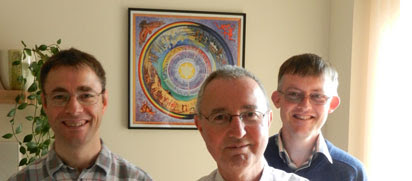
The three of us believe that responding to the need for English is a great service to the community, perhaps the greatest service we can offer. The time for looking around and trying to understand the neighbourhood and its dynamics is over, it is now time to make decisions about how to insert ourselves into concrete action. Helping with English seems the right choice. The need for English is there, not just from the point of view of integration and cohesion, but as a felt need of the people themselves.
Monday, 15 June 2009
Wednesday, 25 March 2009
Mistaken
Birmingham Central Market is not only a good place for shopping, it is also a place where one can meet people from all over the world looking for cheap goods and foods. Even without striking a bargain oneself it is an entertaining place just to walk around in.
Last week I saw a guy there dressed like a tramp, unshaven and dishevelled. He took a few unsteady steps before he toppled over in front of my feet. He had not seen the line that fastened a billboard to the ground. He had trouble to get up by himself, so I helped him together with a companion of his who was his look-alike in appearance. Behind me I heard a guy say: "One drink too much for sure"; and it was exactly what I had thought myself. But bending over him trying to get him up I noticed no smell of alcohol whatsoever and the same applied to his companion whose face came near mine. They were as sober as new-born babies.
The realisation jolted me, wrong again! I try so hard to be open and to do away with prejudices and preconceived ideas, but time and again I am caught out. It brings home forcefully that it is nearly impossible to erase from heart and mind what has found its way in there over many years. The only thing I can do is to keep on trying.
Since the incident I became more aware of behaviour that can often been seen in Aston, but which until now had not really sunk in as significant. Most people here in Aston are Asian and they are supposed to have come from a strongly patriarchal culture. You would expect that the roles of men and women are clearly delineated: the women mostly confined to the affairs of the home and the men in charge of everything else. It struck me, now, that in fact many men are involved in the household shopping, either on their own or together with their families, not just the younger men but the older men as well. Perhaps more strikingly, it is not uncommon (although far from general) to see young fathers push the pram while their wives are walking beside them.
I have no idea whether these observations reflect an adaptation to English society or fall somehow within the behavioural patterns of the original culture. Whatever is the case, the point is that my presupposition was wrong and needs revision on account of that.
Ton
Last week I saw a guy there dressed like a tramp, unshaven and dishevelled. He took a few unsteady steps before he toppled over in front of my feet. He had not seen the line that fastened a billboard to the ground. He had trouble to get up by himself, so I helped him together with a companion of his who was his look-alike in appearance. Behind me I heard a guy say: "One drink too much for sure"; and it was exactly what I had thought myself. But bending over him trying to get him up I noticed no smell of alcohol whatsoever and the same applied to his companion whose face came near mine. They were as sober as new-born babies.
The realisation jolted me, wrong again! I try so hard to be open and to do away with prejudices and preconceived ideas, but time and again I am caught out. It brings home forcefully that it is nearly impossible to erase from heart and mind what has found its way in there over many years. The only thing I can do is to keep on trying.
Since the incident I became more aware of behaviour that can often been seen in Aston, but which until now had not really sunk in as significant. Most people here in Aston are Asian and they are supposed to have come from a strongly patriarchal culture. You would expect that the roles of men and women are clearly delineated: the women mostly confined to the affairs of the home and the men in charge of everything else. It struck me, now, that in fact many men are involved in the household shopping, either on their own or together with their families, not just the younger men but the older men as well. Perhaps more strikingly, it is not uncommon (although far from general) to see young fathers push the pram while their wives are walking beside them.
I have no idea whether these observations reflect an adaptation to English society or fall somehow within the behavioural patterns of the original culture. Whatever is the case, the point is that my presupposition was wrong and needs revision on account of that.
Ton
Wednesday, 25 February 2009
Villa Park

The most impressive structure in Aston is Villa Park, the football stadium of Aston Villa, the premier league football club in Aston, which proudly displays its year of establishment: 1874. The football club does very well and ranks momentarily fourth in the premier league table.
Villa Park has a capacity of 42,640 seats and due to the fact that it is often filled to capacity there are plans to expand the number of seats up to 50,000. In contrast, the neighbourhood of Aston counts only 27,000 inhabitants, which means that on match days Aston is flooded with people outnumbering by far the local population. They all flock to Villa Park changing temporarily the character of the neighbourhood: from mostly Asian to predominantly white. It is indeed conspicuous that most of the fans of Aston Villa come from outside the neighbourhood and belong to the white section of English society.
So far I have attended only two matches of Aston Villa. The first was prompted by a promotional offer of Aston Villa trying to bring more local people into the stadium. Tickets for Aston residents were reduced from £20 or 30 pounds to just £5 pounds and it worked. In the section Mark and I had our seats, there were many Asian people. In fact, we learned about the promotional offer from our Bangladeshi neighbours. No reductions were offered for the second game and this showed as well: Asian people were conspicuously absent. Apparently, the normal prices of the tickets are too much for the local residents who suffer from low income and high unemployment. My impression is that they would like to be counted among the fans but that sadly the cost of the tickets is prohibitive.
It was quite an experience to attend the two matches. One was a win and the other a draw, but in both cases the crowd was fantastic from the beginning to the end, moving as one in urging the players on to go all out and win the game. The shouting, singing, waving and wailing approached ritual proportions. Indeed, football has often been compared with a religious ritual taking place on the "holy ground" of the stadium and uniting people of all walks of life around the heroes in the centre, the modern-day saints. Whatever is true of this comparison football has surely the capacity to build up and to break down community relations. Hopefully, in the case of Aston Villa, the club succeeds in building up an inclusive community, not just of those living outside Aston but foremost of the residents themselves. It is in line of the club's intention to be committed to equality.
Ton
Friday, 16 January 2009
Mansfield Green
Aston is a innercity neighbourhood with few green spaces. The largest is Aston Park adjacent to Aston Hall, the stately mansion constructed by the Holte family in the 17th century. It is presently being restored together with the park for £10 million. I consider the park my lifeline and frequent it on my daily walks around the neighbourhood.
Closer to our house is another green space, called Mansfield Green. It can in no way compare with Aston park, still it is a breathing space in a neighbourhood crisscrossed by streets and full of buildings. The green space has not always been there: a map of Aston in our house, dated 1917, shows that what is now Mansfield Green was at that time packed with houses.
Unfortunately Mansfield Green is not fully appreciated for the rarity that it is. Littering is a problem in the whole of Aston, but Mansfield Green receives more than its share. The corner closest to our house seems to be the favourite dumping ground of drivers who stop at Mansfield Road to unload their often bulky rubbish onto the grass. Mansfield Green contains a small football field, but it is much less used than one would like to see. The reason seems to be that Mansfield Green lacks maintenance and is even dangerous because of holes hidden in the grass.
The Mansfield Residents Forum likes to see Mansfield Green developed. What they have in mind is rather simple: make it into a park by putting a fence around the area, laying out some paths through it and lining them with benches. A proper playground is to be constructed as well.
It has been a frustrating business. Aston Pride, the regeneration agency for Aston, has conducted two consultations among residents and claims that 52% of the respondents were in favour of constructing a community centre on Mansfield Green. The Mansfield Residents Forum cannot believe that the stated figure is true and would like to scrutinise how it was arrived at, but up to now they have never seen a written copy of the report.
Aston Pride admits that there is no shortage of community facilities in Aston implying that a new community centre is not really needed, but they are said to find it difficult to simply drop it in favour of a park, because one of the three city councillors from Aston is championing the community centre. Bureaucracy is another factor complicating the park proposal. Mansfield Green is owned by the Birmingham City Council with the housing department as the responsible agency, the area still being classified as a housing site. Reclassification of the site is necessary in order to guarantee the development of the park and its maintenance after establishment. This has not yet happened, as the site may still be needed for housing after all.
A strong Mansfield Residents Forum could mean all the difference. Unfortunately the organisation is rather weak and cannot make much of a noise. In order to make its voice really heard it needs to involve many more residents across the several ethnic groups. Would it be possible? Time would learn, but at least it has Mansfield Green to fight for.
Closer to our house is another green space, called Mansfield Green. It can in no way compare with Aston park, still it is a breathing space in a neighbourhood crisscrossed by streets and full of buildings. The green space has not always been there: a map of Aston in our house, dated 1917, shows that what is now Mansfield Green was at that time packed with houses.
Unfortunately Mansfield Green is not fully appreciated for the rarity that it is. Littering is a problem in the whole of Aston, but Mansfield Green receives more than its share. The corner closest to our house seems to be the favourite dumping ground of drivers who stop at Mansfield Road to unload their often bulky rubbish onto the grass. Mansfield Green contains a small football field, but it is much less used than one would like to see. The reason seems to be that Mansfield Green lacks maintenance and is even dangerous because of holes hidden in the grass.
The Mansfield Residents Forum likes to see Mansfield Green developed. What they have in mind is rather simple: make it into a park by putting a fence around the area, laying out some paths through it and lining them with benches. A proper playground is to be constructed as well.
It has been a frustrating business. Aston Pride, the regeneration agency for Aston, has conducted two consultations among residents and claims that 52% of the respondents were in favour of constructing a community centre on Mansfield Green. The Mansfield Residents Forum cannot believe that the stated figure is true and would like to scrutinise how it was arrived at, but up to now they have never seen a written copy of the report.
Aston Pride admits that there is no shortage of community facilities in Aston implying that a new community centre is not really needed, but they are said to find it difficult to simply drop it in favour of a park, because one of the three city councillors from Aston is championing the community centre. Bureaucracy is another factor complicating the park proposal. Mansfield Green is owned by the Birmingham City Council with the housing department as the responsible agency, the area still being classified as a housing site. Reclassification of the site is necessary in order to guarantee the development of the park and its maintenance after establishment. This has not yet happened, as the site may still be needed for housing after all.
A strong Mansfield Residents Forum could mean all the difference. Unfortunately the organisation is rather weak and cannot make much of a noise. In order to make its voice really heard it needs to involve many more residents across the several ethnic groups. Would it be possible? Time would learn, but at least it has Mansfield Green to fight for.
Monday, 29 December 2008
Mediator?
Walking around Aston a few days after Christmas I got a bit of a scare. A group of four guys were having a row, shouting at each other and gesticulating wildly. Getting a bit nearer I saw that two of them really wanted to have a go at each other and that the others were trying to restrain them. What scared me was that one of the guys who stepped in beween and tried to keep the two protagonists apart, received some blows in the process himself and lost his cool as well. This could become an uneven fight with serious consequences, but fortunately the shouting had alarmed some more people and together they tried to pacify the hotheads. It took some time for the shouting to go down but in the end the two opponents, still glaring angrily at each other, parted ways.
Hopefully this was the end of the row, but it is by no means sure. Newspapers regularly carry stories about knife crimes, in which an initial fight that ended in a draw was decided at a later stage by more violent means. It all depends on how humiliated the aggrieved parties feel and whether the initial problem can be solved. I for one had no idea what the row was all about. The shouting contained some English words but most of it was in, what I suppose, an Asian language from Pakistan or Bangladesh.
Mediation needs true insiders. As long as these are around and willing to commit themselves, escalation of a conflict can be prevented and the peace maintained. The whole incident brought forecefully home to me that I do not belong to that category. I felt very much the outsider, present, but unable to understand and to act.
Ton
Hopefully this was the end of the row, but it is by no means sure. Newspapers regularly carry stories about knife crimes, in which an initial fight that ended in a draw was decided at a later stage by more violent means. It all depends on how humiliated the aggrieved parties feel and whether the initial problem can be solved. I for one had no idea what the row was all about. The shouting contained some English words but most of it was in, what I suppose, an Asian language from Pakistan or Bangladesh.
Mediation needs true insiders. As long as these are around and willing to commit themselves, escalation of a conflict can be prevented and the peace maintained. The whole incident brought forecefully home to me that I do not belong to that category. I felt very much the outsider, present, but unable to understand and to act.
Ton
Wednesday, 5 November 2008
The limits of dialogue
Dialogue may be an exciting thing to do: it is venturing into an unfamiliar world and reaching out to others who are different from ourselves. On the other hand it is hard and demanding work. It is not easy to understand someone who grew up in another culture and has a different outlook on life. When religion is involved it becomes even more difficult: then areas of life are touched which go deep and the deeper they go the more sensitive they become.
Aston is a place where many cultures and many religions are in evidence. Churches and mosques abound and people in all kinds of dress are visible in the streets, from Western style clothes to the Muslim woman in full burqa. The differences are enormous and it is clear that observation does not get one very far. You may register the diversity but in order to enter the mindset of somebody else much more is needed than the look of an outsider.
One way of gaining some understanding is study, reading books and articles preferably written by representatives of the other cultures and religions. Let them talk about themselves and give them a chance to express who they are and how they live. Study is reaching out to them but not yet that close as that they are right in front of you and a perhaps uneasy face-to-face encounter becomes inevitable.
I have been studying Islam for months now and slowly I have gotten some inkling of what the Islam stands for. Time, I thought, to share what I have learned with my fellow members of the Catholic parish in Aston. They too live with Muslims all around them and they too may wonder what goes on in the Muslim world. A basic course on Islam might help them to deepen their contacts with their neighbours and understand both them and themselves better.
The course took place in five sessions. Material was gratefully borrowed from the Church of England and it covered five themes: The Origins of Islam; the Qur'an; Islamic Belief and Practice; Evangelism or Dialogue and Extremism. Attendance varied from 15 to over 20 people, both from Aston and neighbouring parishes. On the whole it went well with the exception of one highly confrontational session. The problem was that some of those present did not want dialogue, they wanted clear pronouncements against Islam and its teachings. They were not after understanding another faith but after proclamation of the Catholic truth in all its clarity.
Anything less would be relativity.
True dialogue does not mean that one gives up one's own convictions. On the contrary these will be brought in into the discussion, but what is definitely needed for dialogue is the willingness to understand the other in his or her faith and appreciate what that faith means to him or her. In the end persons are more important than doctrine and love is of a higher order than truth. When this awareness is absent, dialogue has reached its limits.
Ton
Aston is a place where many cultures and many religions are in evidence. Churches and mosques abound and people in all kinds of dress are visible in the streets, from Western style clothes to the Muslim woman in full burqa. The differences are enormous and it is clear that observation does not get one very far. You may register the diversity but in order to enter the mindset of somebody else much more is needed than the look of an outsider.
One way of gaining some understanding is study, reading books and articles preferably written by representatives of the other cultures and religions. Let them talk about themselves and give them a chance to express who they are and how they live. Study is reaching out to them but not yet that close as that they are right in front of you and a perhaps uneasy face-to-face encounter becomes inevitable.
I have been studying Islam for months now and slowly I have gotten some inkling of what the Islam stands for. Time, I thought, to share what I have learned with my fellow members of the Catholic parish in Aston. They too live with Muslims all around them and they too may wonder what goes on in the Muslim world. A basic course on Islam might help them to deepen their contacts with their neighbours and understand both them and themselves better.
The course took place in five sessions. Material was gratefully borrowed from the Church of England and it covered five themes: The Origins of Islam; the Qur'an; Islamic Belief and Practice; Evangelism or Dialogue and Extremism. Attendance varied from 15 to over 20 people, both from Aston and neighbouring parishes. On the whole it went well with the exception of one highly confrontational session. The problem was that some of those present did not want dialogue, they wanted clear pronouncements against Islam and its teachings. They were not after understanding another faith but after proclamation of the Catholic truth in all its clarity.
Anything less would be relativity.
True dialogue does not mean that one gives up one's own convictions. On the contrary these will be brought in into the discussion, but what is definitely needed for dialogue is the willingness to understand the other in his or her faith and appreciate what that faith means to him or her. In the end persons are more important than doctrine and love is of a higher order than truth. When this awareness is absent, dialogue has reached its limits.
Ton
Wednesday, 8 October 2008
Dogs
A radio newsitem on October 6 caught my attention. It said that for the first time a guide dog was allowed to enter a mosque in Leicester at prayer time together with its owner. The decision or fatwa was heralded by a mosque leader as a breakthrough and he hoped that many mosques all-over the United Kingdom would follow this example: guide dogs are no longer to be considered as unclean when they take their blind owners to say their prayers in the mosque. He added by way of assurance that guide dogs are well-trained and well-behaving dogs that do not disturb the praying service in any way.
The newsitem brought home to me that indeed in the predominantly Muslim neighbourhood of Aston one hardly sees a dog. I am in the habit of making daily tours through the neighbourhood on foot and it is only rarely that I see dog-owners walking their dogs and they, the dog-owners that is, are mostly white. In a garden not far at the back of our house a large dog can be seen and heard occasionally, jumping and barking around, but its owner is distinctly West-Indian. The Muslim population of mostly Pakistani and Bangladeshi do not seem to take to dogs. Cats is a different story, we see them daily in a balancing act crossing the wooden fence of our garden.
So I was utterly surprised while reading the reminiscences of Dr. Mohammed Naseem, the chairman of the Birmingham Central Mosque since 1975. His piece was first published in the Birmingham Mail of 15th July 2006. He recalls his visits to a park as a child and how he loved the roses on display. The part that suprised me said: "I love dogs too, they are beautiful creatures, so loyal, so devoted. They have only one mission in their lives - to serve and please their masters. They have a total commitment that we humans can learn from. They also come in different colours - white, brown, black, grey and even spotted. It is a joy to visit the annual dog show. The display of colours and quality takes me back to my days of the visits to the park."
Of course, Dr. Naseem does not say that he ever owned a dog himself. He may be simply talking about a love from afar. Still, it is remarkable that he publicly declares his love for dogs, while other Muslims consider them as unclean. I have not yet been able to figure out how this incongruity is possible, but the one conclusion I felt safe to draw for myself is, that caution is needed in approaching the belief system of another religion. It may be more complicated than it seems at first sight.
Ton
The newsitem brought home to me that indeed in the predominantly Muslim neighbourhood of Aston one hardly sees a dog. I am in the habit of making daily tours through the neighbourhood on foot and it is only rarely that I see dog-owners walking their dogs and they, the dog-owners that is, are mostly white. In a garden not far at the back of our house a large dog can be seen and heard occasionally, jumping and barking around, but its owner is distinctly West-Indian. The Muslim population of mostly Pakistani and Bangladeshi do not seem to take to dogs. Cats is a different story, we see them daily in a balancing act crossing the wooden fence of our garden.
So I was utterly surprised while reading the reminiscences of Dr. Mohammed Naseem, the chairman of the Birmingham Central Mosque since 1975. His piece was first published in the Birmingham Mail of 15th July 2006. He recalls his visits to a park as a child and how he loved the roses on display. The part that suprised me said: "I love dogs too, they are beautiful creatures, so loyal, so devoted. They have only one mission in their lives - to serve and please their masters. They have a total commitment that we humans can learn from. They also come in different colours - white, brown, black, grey and even spotted. It is a joy to visit the annual dog show. The display of colours and quality takes me back to my days of the visits to the park."
Of course, Dr. Naseem does not say that he ever owned a dog himself. He may be simply talking about a love from afar. Still, it is remarkable that he publicly declares his love for dogs, while other Muslims consider them as unclean. I have not yet been able to figure out how this incongruity is possible, but the one conclusion I felt safe to draw for myself is, that caution is needed in approaching the belief system of another religion. It may be more complicated than it seems at first sight.
Ton
Wednesday, 6 August 2008
Mosques
Aston has plenty of mosques, big and small. I have not yet counted them all but surely they number over ten. In addition you have Islamic centres that are not connected with a mosque. Both mosques and Islamic centres make the presence of Islam very pronounced in Aston. Without doubt it is the religion of the majority of the population. On Fridays this fact shows itself in another way. The mosques are crowded by the faithful and the streets around them by their cars.
It is not so easy to chart what particular strand of Islam each mosque represents. As a start it would be needed to go around, paper and pencil in hand, and list down all the names that are written on the mosques, hopefully they are in English as well as in Arabic or other scripts. So far I have been hesitant to do so, as if I felt exposing myself to accusations of spying on other people's lives and sacred beliefs. Perhaps I am too sensitive, for I was told that nothing more may be involved than people from the same village in Pakistan or Bangladesh putting up theitr own mosque and having their own imam.
So far I have been in only two mosques, one in Aston and one in the city centre, both were rather large mosques that catered to Muslims of various countries of origin and used several languages in their Friday services. Some time ago a Muslim youth leader told us that only one mosque in Aston had an English speaking imam, but since then we found out that at least one other mosque should be added to this short list.
The question of language is a sensitive issue. The Qur'an is written in Arabic and Muslims believe that only the Arabic version is the true word of God. Any preacher should be able to read the Qur'an in the original language and explain the meaning of it to the congregation in a language they understand. Imams cannot do so without study and it is still the case that most opportunities for studying the Qur'an are found in Muslim countries. Also many of the mosque-goers, in particular the older men who are most faithful in going to the prayer services, have a poor command of the English language. They get by in the ordinary matters of daily life, but for more intricate discussions about issues of faith their knowledge of English falls short. Then for them the word of God becomes more important than the language of this country.
Ton
It is not so easy to chart what particular strand of Islam each mosque represents. As a start it would be needed to go around, paper and pencil in hand, and list down all the names that are written on the mosques, hopefully they are in English as well as in Arabic or other scripts. So far I have been hesitant to do so, as if I felt exposing myself to accusations of spying on other people's lives and sacred beliefs. Perhaps I am too sensitive, for I was told that nothing more may be involved than people from the same village in Pakistan or Bangladesh putting up theitr own mosque and having their own imam.
So far I have been in only two mosques, one in Aston and one in the city centre, both were rather large mosques that catered to Muslims of various countries of origin and used several languages in their Friday services. Some time ago a Muslim youth leader told us that only one mosque in Aston had an English speaking imam, but since then we found out that at least one other mosque should be added to this short list.
The question of language is a sensitive issue. The Qur'an is written in Arabic and Muslims believe that only the Arabic version is the true word of God. Any preacher should be able to read the Qur'an in the original language and explain the meaning of it to the congregation in a language they understand. Imams cannot do so without study and it is still the case that most opportunities for studying the Qur'an are found in Muslim countries. Also many of the mosque-goers, in particular the older men who are most faithful in going to the prayer services, have a poor command of the English language. They get by in the ordinary matters of daily life, but for more intricate discussions about issues of faith their knowledge of English falls short. Then for them the word of God becomes more important than the language of this country.
Ton
Wednesday, 25 June 2008
Aston Heritage Day
It was a splendid idea to declare the 21st of June Aston Heritage Day. Aston does not have an enviable reputation being rather associated with gangs and violence, so a move to put the neighbourhood in a positive light is only to be applauded. After all, gangs and violence cause anxiety once in a while but they are definitely not the order of the day.
The occasion was announced by banners and a lot of flyers in public spaces: "Take the Aston Challenge and let Aston amaze you". It is indeed amazing that a deprived, innercity neighbourhood lists no less than 12 sites of memorable distinction. Part of the explanation lies in the fact that up to 1911 Aston had a political standing of its own, not yet being incorporated in the expanding City of Birmingham. The old magistrates' court from that period is now a training centre for youth with emphasis on the arts and the old Council House, while continuing to be the home of the Aston Library, now contains the offices of Aston pride, the regeneration programme for the neighbourhood.
The Heritage Day lasted from 11:30am to 4:00pm, a total of 4 hours and 30 minutes or 270 minutes altogether. The flyer announced that all adults who visited all 12 venues on that day would be entered in a Prize Draw, the prize being a stadium tour of Aston Villa followed by a lunch for two at the nearby Holte Hotel. I wonder whether anyone went for that! They would have had only 22.5 minutes per venue including moving from one site to another. The only way to have a chance was by not lingering at places at all, just get your sticker and jump in your car again.
I myself went around on foot and saw half of the venues. What struck me was the big difference in historical awareness. At some of the places those receiving the visitors gave an overview of what went on in their particular building from the time of its construction up to now. Aston Hall was a good example of that. Others seemed only interested in the present, in the activities as they are going on today without any sense of how much has changed over the years.
One nice aspect of a heritage day is that you have access to parts of buildings which are normally closed to the public. One instance of this is that you are allowed below ground level and that you can see for yourself how much space is unused or used for so-called storage. There has been a proposal in Aston to convert part of Mansfield Green into a community centre. It seems to me that before any scarse green space is taken up by yet another building, refurbishing of underused parts of already existing buildings deserves to be looked into. It may turn out to be better for the heritage of Aston and better for the environment.
Ton
The occasion was announced by banners and a lot of flyers in public spaces: "Take the Aston Challenge and let Aston amaze you". It is indeed amazing that a deprived, innercity neighbourhood lists no less than 12 sites of memorable distinction. Part of the explanation lies in the fact that up to 1911 Aston had a political standing of its own, not yet being incorporated in the expanding City of Birmingham. The old magistrates' court from that period is now a training centre for youth with emphasis on the arts and the old Council House, while continuing to be the home of the Aston Library, now contains the offices of Aston pride, the regeneration programme for the neighbourhood.
The Heritage Day lasted from 11:30am to 4:00pm, a total of 4 hours and 30 minutes or 270 minutes altogether. The flyer announced that all adults who visited all 12 venues on that day would be entered in a Prize Draw, the prize being a stadium tour of Aston Villa followed by a lunch for two at the nearby Holte Hotel. I wonder whether anyone went for that! They would have had only 22.5 minutes per venue including moving from one site to another. The only way to have a chance was by not lingering at places at all, just get your sticker and jump in your car again.
I myself went around on foot and saw half of the venues. What struck me was the big difference in historical awareness. At some of the places those receiving the visitors gave an overview of what went on in their particular building from the time of its construction up to now. Aston Hall was a good example of that. Others seemed only interested in the present, in the activities as they are going on today without any sense of how much has changed over the years.
One nice aspect of a heritage day is that you have access to parts of buildings which are normally closed to the public. One instance of this is that you are allowed below ground level and that you can see for yourself how much space is unused or used for so-called storage. There has been a proposal in Aston to convert part of Mansfield Green into a community centre. It seems to me that before any scarse green space is taken up by yet another building, refurbishing of underused parts of already existing buildings deserves to be looked into. It may turn out to be better for the heritage of Aston and better for the environment.
Ton
Thursday, 8 May 2008
Bridging
A bridge connects two riverbanks running from one side to the other. I like bridges with an arch, not just because they are more pleasing to the eye, but because they make it more difficult for a walking person to reach the other side. You have to put in an effort first and only when you have reached the highest point does it become easier to complete the crossing. At the same time the upward slant of the bridge no longer blocks your view and you can see what lies ahead of you without restriction.
After seven months in Aston our Cordate Community is still trying to make its way up the bridge and we have not yet reached the easing-off point. We never thought we would in such a short time. In our planning we have given ourselves at least one year to immerse ourselves in the neighbourhood.
We are not the only ones negotiating the bridge of intercultural relationships. For seven years a regeneration project has been going on in Aston. It is a ten-year programme and by now it should have scaled the highest point of the bridge, but I wonder whether they have succeeded in doing so. Recently I attended a meeting called by the health coordinator of the programme in the area. The various faith groups were invited, meaning in fact representatives of the many churches and mosques in the neighbourhood. They did not show up in great numbers, in fact only a few mosques and churches were represented. More telling perhaps than the disappointing attendance was the topic of the meeting. It was all about seeking the cooperation of the faith groups in getting the health and family services of the programme delivered to the target groups. Apparently, they had reason to believe that the needs for health care and family assistance were there, but the services meant to answer those needs were not sufficiently availed of by the population.
The programme is not wanting in effort. They are willing to be flexible in time and place. If the people could only make it in the evenings or during weekends, so be it. They would adjust their schedules accordingly. If the people wanted them to go to the places where they feel at home, like their churches or mosques, no problem. They would rent space there, if possible, and so make themselves available right on the spot where the people want them.
It is not so easy to pinpoint why this bridge has not been crossed. Does the problem lie with the programme in spite of their great willingness to serve? Did they somehow make the wrong start having difficulty ever since in connecting with the people? Or does the problem lie with the people who prefer their own problem-solving, even if deficient, and rather keep to themselves? One suspects that cultural differences on both sides make it difficult to shuffle up the bridge. Running or walking is definitely out of the question.
Ton
After seven months in Aston our Cordate Community is still trying to make its way up the bridge and we have not yet reached the easing-off point. We never thought we would in such a short time. In our planning we have given ourselves at least one year to immerse ourselves in the neighbourhood.
We are not the only ones negotiating the bridge of intercultural relationships. For seven years a regeneration project has been going on in Aston. It is a ten-year programme and by now it should have scaled the highest point of the bridge, but I wonder whether they have succeeded in doing so. Recently I attended a meeting called by the health coordinator of the programme in the area. The various faith groups were invited, meaning in fact representatives of the many churches and mosques in the neighbourhood. They did not show up in great numbers, in fact only a few mosques and churches were represented. More telling perhaps than the disappointing attendance was the topic of the meeting. It was all about seeking the cooperation of the faith groups in getting the health and family services of the programme delivered to the target groups. Apparently, they had reason to believe that the needs for health care and family assistance were there, but the services meant to answer those needs were not sufficiently availed of by the population.
The programme is not wanting in effort. They are willing to be flexible in time and place. If the people could only make it in the evenings or during weekends, so be it. They would adjust their schedules accordingly. If the people wanted them to go to the places where they feel at home, like their churches or mosques, no problem. They would rent space there, if possible, and so make themselves available right on the spot where the people want them.
It is not so easy to pinpoint why this bridge has not been crossed. Does the problem lie with the programme in spite of their great willingness to serve? Did they somehow make the wrong start having difficulty ever since in connecting with the people? Or does the problem lie with the people who prefer their own problem-solving, even if deficient, and rather keep to themselves? One suspects that cultural differences on both sides make it difficult to shuffle up the bridge. Running or walking is definitely out of the question.
Ton
Subscribe to:
Posts (Atom)